New pool decks in Palm Bay, poured coping-tight and pitched to drain
A new pool deck has to meet the coping cleanly, slope away from the water, carry the screen cage on proper footings and stay cool enough to walk on in August. We pour them for new pools, replace decks that have failed, and extend decks that were always too small.
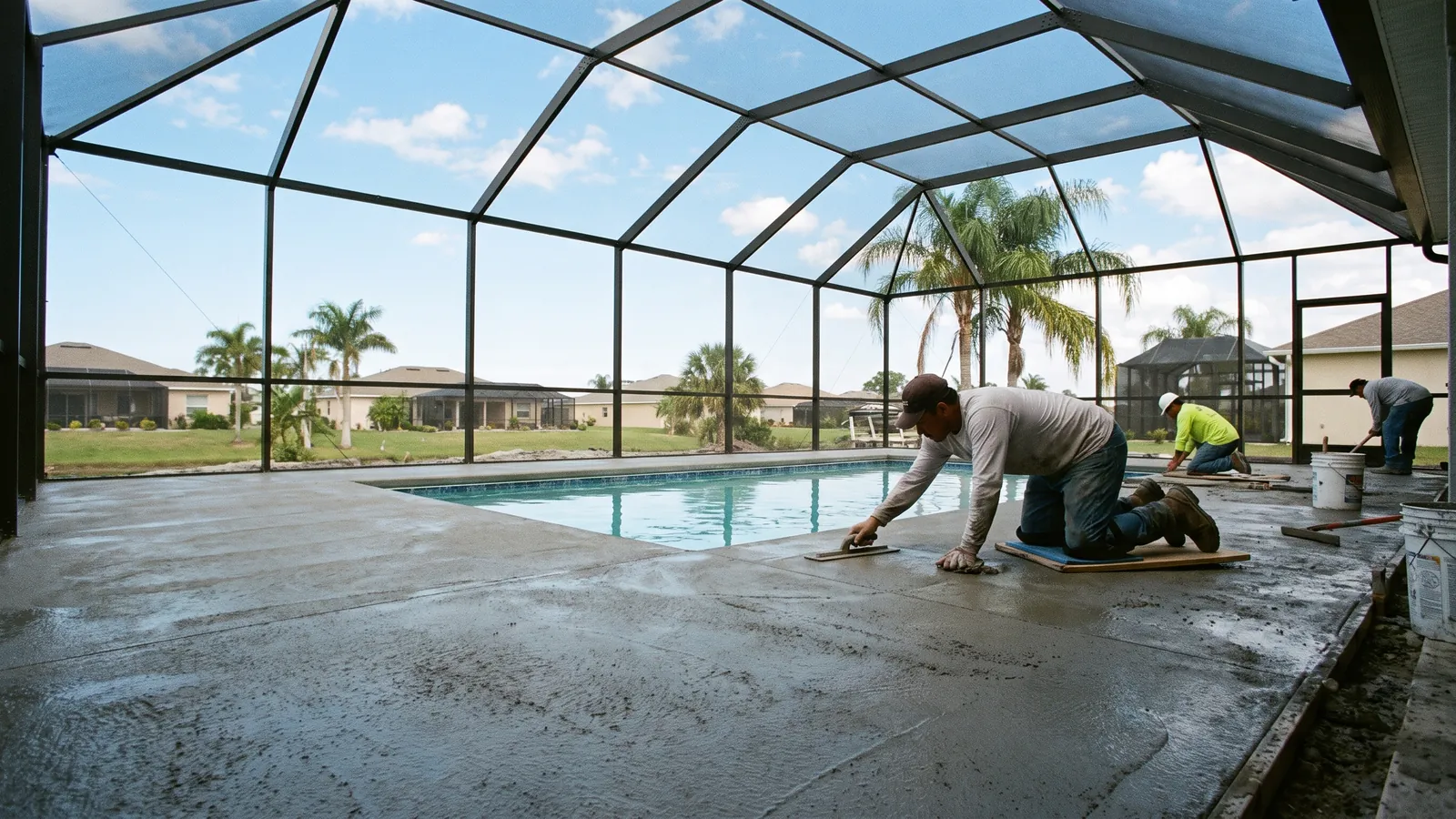
Palm Bay has thousands of backyard pools inside screen enclosures, most of them built between 1985 and 2007, and the deck around the pool is often the part that's given up first: settled where the pool contractor backfilled the excavation and never compacted it, separated from the coping by a joint that's opened an inch, spalled by chlorine and sun, or simply too narrow to put a lounge chair on. We pour new pool decks for new pools — working with the pool builder so the deck goes in after the shell and the plumbing are inspected — and we replace or extend decks on existing pools.
The details that matter: a base that's actually compacted, especially the loose backfill around the pool shell; an expansion joint at the coping with a proper sealant so the deck and the pool can move independently without the deck lifting the coping; a slope of about a quarter inch per foot away from the water so rain and splash-out run to the deck drains or the cage edge, not back into the pool; footings for the enclosure columns where the screen company's engineering puts them; a textured or knockdown finish that isn't slick when wet and doesn't burn feet; and a sealer against UV and chlorine. Four inches of fiber-reinforced 3,000 psi concrete with wire on chairs, jointed on a grid that follows the pool's shape. If the existing slab is sound and just ugly, we'll tell you to resurface it instead — it's a third of the price.
What's included
Compacted backfill
The loose fill around a pool shell is why decks settle; we compact it in lifts before anything is poured.
Coping expansion joint
A true expansion joint at the coping, sealed with a flexible sealant, so the deck never lifts or cracks the coping.
Pitched away from the water
About a quarter inch per foot toward the deck drains or the cage edge, so splash-out and rain leave the pool area.
Cage column footings
Footings sized and placed to the enclosure engineering, coordinated with the screen contractor.
Textured, cool finish
Knockdown or broom texture that grips wet feet and reflects heat, sealed against UV and chlorine.
Permit coordination
For a new pool, the deck is part of the pool permit; for a deck replacement inside an existing cage we confirm what the Building Division wants before we start.
Pool decks cost in Palm Bay, FL
| Job | Typical price | Notes |
|---|---|---|
| New pool deck, textured, 4" (400–600 sq ft) | $5,600 – $10,800 | Excludes pool, cage |
| Replace failed deck inside existing cage (400–600 sq ft) | $7,200 – $13,500 | Tear-out, compaction, new pour |
| Deck extension to widen a narrow deck (100–200 sq ft) | $1,600 – $3,600 | Doweled and matched |
| Cage-footing slab for a new or larger enclosure | $2,400 – $5,200 | To enclosure engineering |
| Deck drains and coping joint reseal | $600 – $1,800 | Add-on or stand-alone |
| Knockdown resurfacing of a sound deck (500 sq ft) | $2,500 – $4,500 | See resurfacing |
These are 2026 Brevard County ranges so you can budget. Your written price is itemized — demolition and haul-off, base, thickness and steel, finish, joints, sealing, permit — and good for 30 days.
Recent work
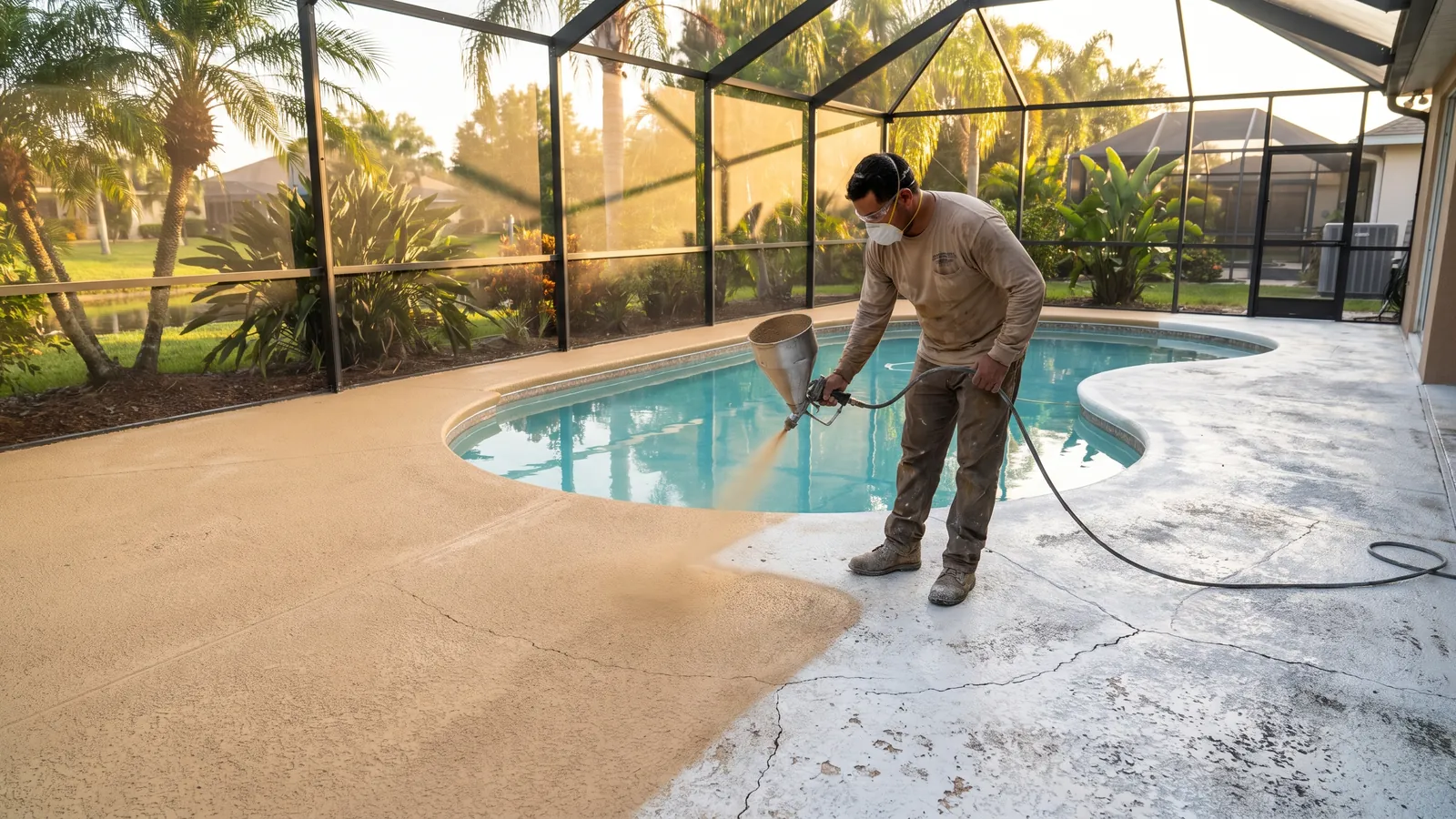
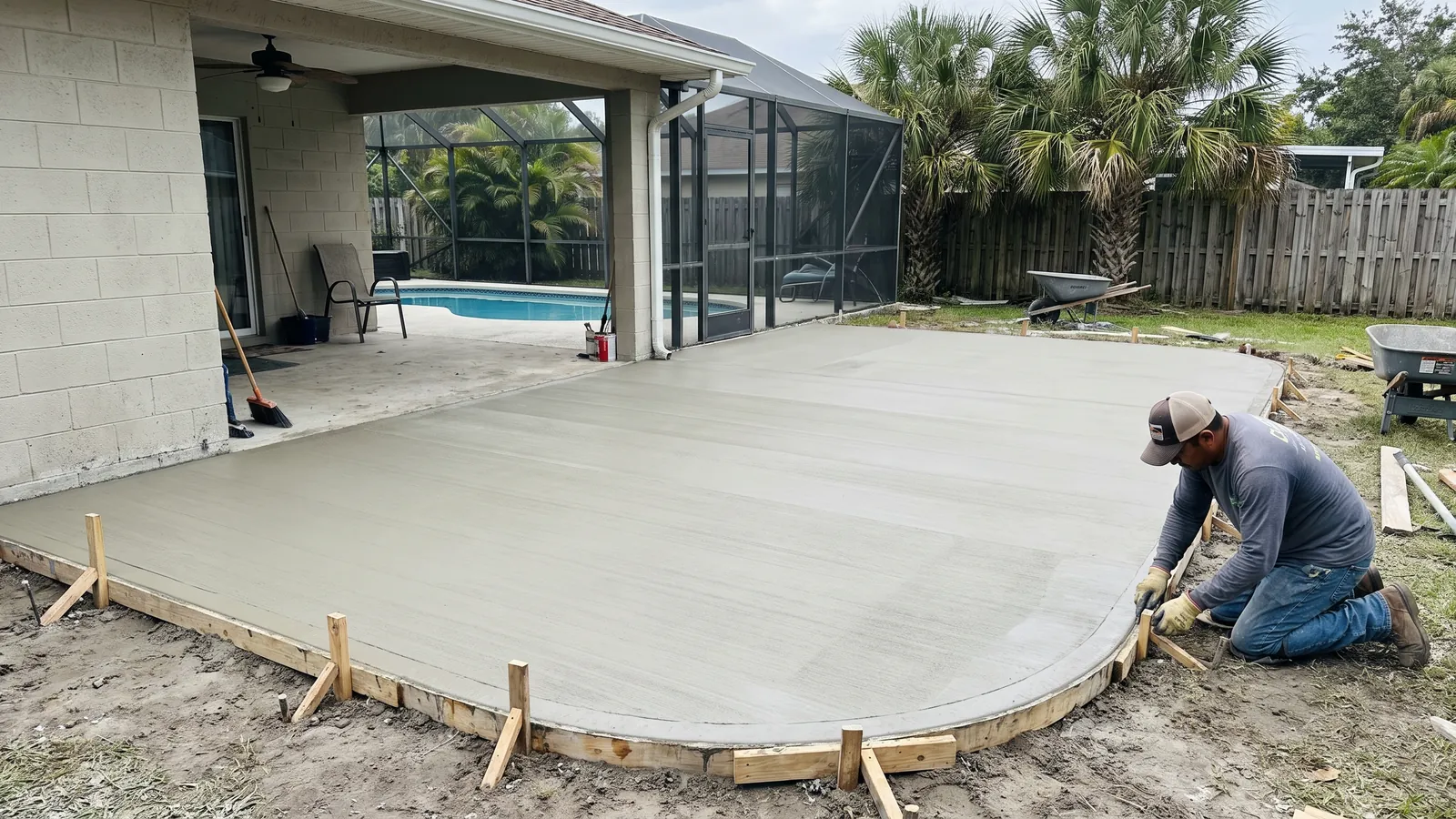
Questions we get about pool decks
Should I replace or resurface my pool deck?
Walk it and listen. If the deck is level, doesn't rock, the coping joint is tight and the problems are surface — chalking, hairline cracks, stains, heat — resurface it with a knockdown overlay for a third of the cost. If it's sunk, heaved, separated from the coping, has cracks you can put a coin in, or is pulling the cage posts, replace it. We'll tell you which on the site visit, and we don't sell new decks to people who need overlays.
Can you pour the deck while the pool is being built?
Yes, and it's the right sequence: after the shell, plumbing and electrical are in and inspected, before the cage goes up. We coordinate with the pool contractor and the screen company so the deck is at the right height for the coping and the footings are where the enclosure posts land.
How long before I can use the pool?
The deck is walkable in 24 hours and the cage company can set posts after the cure the engineering calls for, usually seven days. If we're sealing, add a day for the sealer to dry. The pool itself is usable as soon as the deck is walkable and any construction debris is out of it.
Will a new deck crack?
Concrete cracks; the trade is deciding where. We cut control joints on a grid that follows the pool's shape so shrinkage cracks happen inside the joints where you can't see them, put fiber in the mix and wire in the slab so any crack stays tight, and compact the base so the deck doesn't crack from settlement — which is what actually breaks decks here.