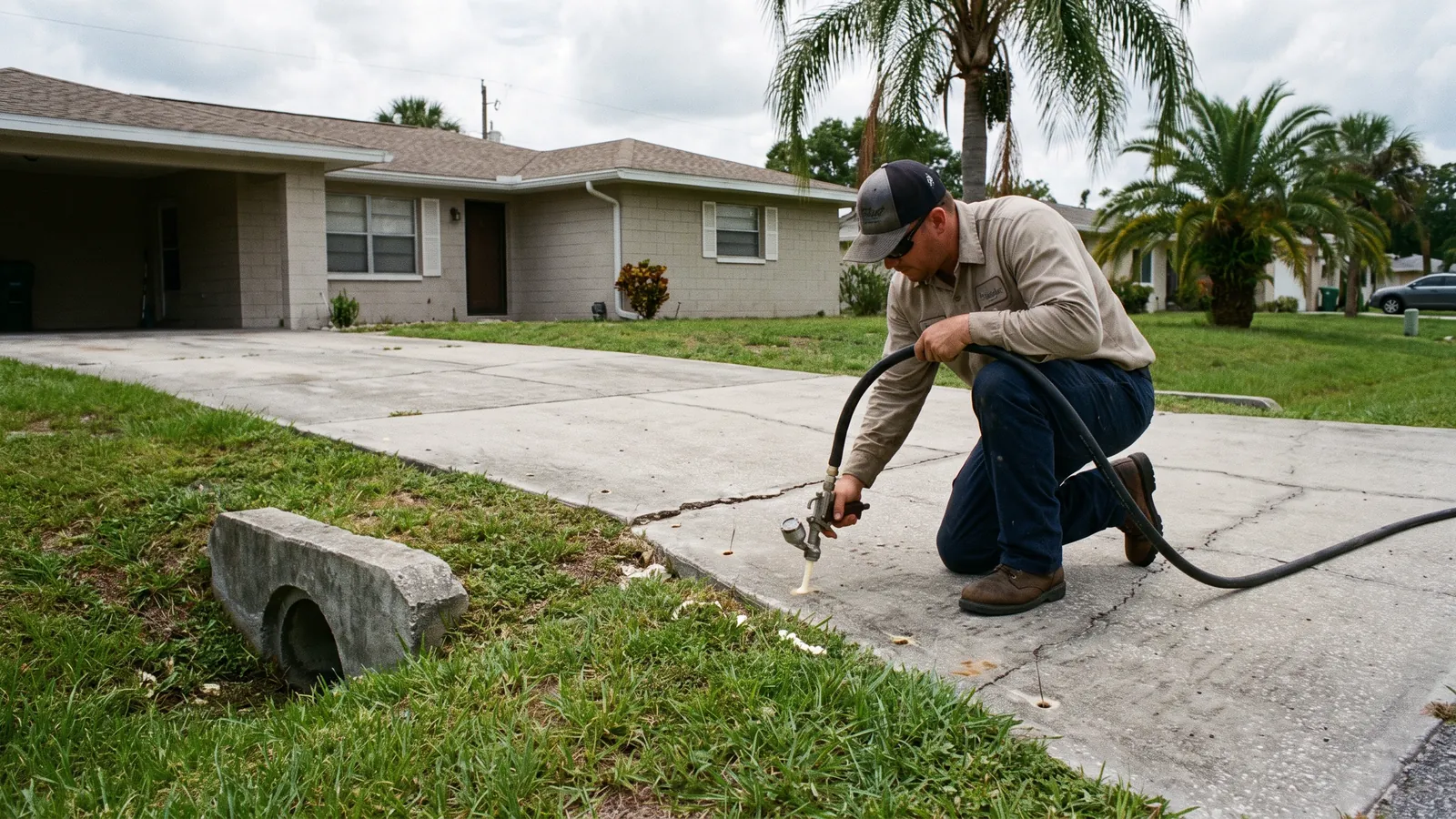
We get asked every week why a driveway that was "fine for years" suddenly dropped at the street, or why a pool deck has a crack you can put a coin in. The concrete almost never did it. Here's what did, in the order we see it.
1. The swale took the sand out from under the apron
The single biggest cause of sunken concrete in Palm Bay. The culvert ends silt up or get crushed, the swale erodes, the neighbor fills theirs, water runs under the apron instead of through the pipe, and the sand goes with it. The apron drops an inch or two at the road and cracks across the pipe. Fix: clear or replace the culvert, regrade the swale, then foam-lift a sound apron or replace a broken one — all under the Public Works permit. Lifting without fixing the water is a three-year fix.
2. Nobody compacted the base
Flatwoods sand looks firm and isn't. Poured on as it was found, it consolidates under the first summer of traffic and rain, and the slab settles unevenly — more where the fill was deepest, less where the sand was native. Boom-era driveways in Bayside Lakes and the SW, and most of the original GDC pours, were done this way. Fix: there's no fix for the base under an existing slab except lifting it with foam, which fills the voids. For a new pour, the base is compacted in lifts, and that's the whole difference.
3. The water table came up
In September the water table under much of Palm Bay is a foot or two below the grass, and on the low western blocks near the St. Johns marsh it's at the surface. A slab whose base sits in that water loses support every wet season and regains it every dry season — a pumping action that opens cracks. Fix: build the base up above the wet-season grade, and keep the slab's edges drained. We look at the low corner on every site visit.
4. The pool backfill settled
When a pool shell goes in, the over-excavation around it gets backfilled with loose sand, and the deck gets poured on it a few weeks later. The backfill consolidates for years. The deck settles toward the pool, the coping joint opens, and the deck cracks in an arc a few feet out from the coping. Fix: foam-lift the deck and reseal the coping joint if the slab is sound; replace it on properly compacted backfill if it isn't.
5. A downspout aimed at the corner
A roof drops thousands of gallons on a lanai or garage-side slab corner in one storm. Twenty years of that erodes the base at that corner, and the slab tips. Fix: extend the downspout past the slab or into a drain, then lift or replace the slab. The downspout line item is $150 and it's not optional on our jobs.
6. Roots, sprinklers and Chevys
Laurel oaks in the NE units lift walks and driveways from below; sprinkler heads that hit the same spot every morning for thirty years erode the edge and scale the surface; a driveway poured at two and a half inches with no steel wasn't built for a full-size pickup. Fix: cut or bridge the root, move the head, and pour the replacement at four inches with fiber and wire.
7. Salt
On the beachside and along the lagoon, chloride reaches the steel inside the slab, the steel rusts and expands, and the surface pops off along the rebar lines. Fix: denser concrete, steel at proper cover, sealer on a schedule. It doesn't stop salt; it slows it by a decade or two.
What "cracked" actually means
A hairline crack inside a control joint is the concrete doing what it's supposed to. A hairline crack across a field with no vertical offset is shrinkage, and it's cosmetic. A crack you can put a coin in, or one with a lip you can feel with your foot, is movement — one of the seven things above — and the fix is the cause first, the concrete second. Call us and we'll tell you which one you have from the photo, before anyone comes out.
Common questions
Can a sunken slab be lifted?
If it's sound — not broken into a puzzle — yes, with polyurethane foam injected through dime-sized holes, in an hour or two, at a fraction of replacement. If it's the original two-inch GDC pour, it'll break when it moves and replacement is the honest answer.
Why did my driveway crack right down the middle?
Usually a sprinkler line or a downspout on one side eroding the base, or a slab poured with no control joints so it picked its own — and a slab with no steel in it opens wide where it cracks. A new pour with joints on a grid and wire in the middle cracks in the joints, where you can't see it.
Is the sand here really that bad?
Flatwoods sand is fine to build on when it's compacted and drained. It's the water — the swale, the water table, the downspout — that makes it move. Fix the water and Palm Bay sand will hold a slab for fifty years.
Do you fix the drainage or just the concrete?
Both, every time. A lift or a replacement quote from us includes the culvert, the swale, the downspout or the root that caused it, because leaving the cause is how we'd end up back at your house in three years.
Related: Repair & leveling · Culverts & swale aprons · Pool deck resurfacing · Permits & swales guide